The case of the generic 'sh'
Every launchd agent on my Mac showed up as 'sh' in Activity Monitor. A small Rust wrapper built by Nix restored their names and kept the /nix/store wait.
For months, Activity Monitor on my Mac showed processes called sh. There was never just one, and the number depended on what had started at boot. Clicking one and opening "Open Files and Ports" gave no path back to gpg-agent, the CodeArtifact token refresher, or the Bedrock credential minter. Every background agent I had declared in home-manager reported itself under the same name. If one of them pegged a core or leaked file descriptors, Activity Monitor could not tell me which.
This post traces what sh was, why home-manager's own fix does not work for agents that run at login, and the short Nix file (nix/pkgs/wait-then-exec.nix, a small Rust program wrapped in a derivation) that closes the gap. The macOS migration in Part 6 hit an earlier case of a default shell getting in the way.
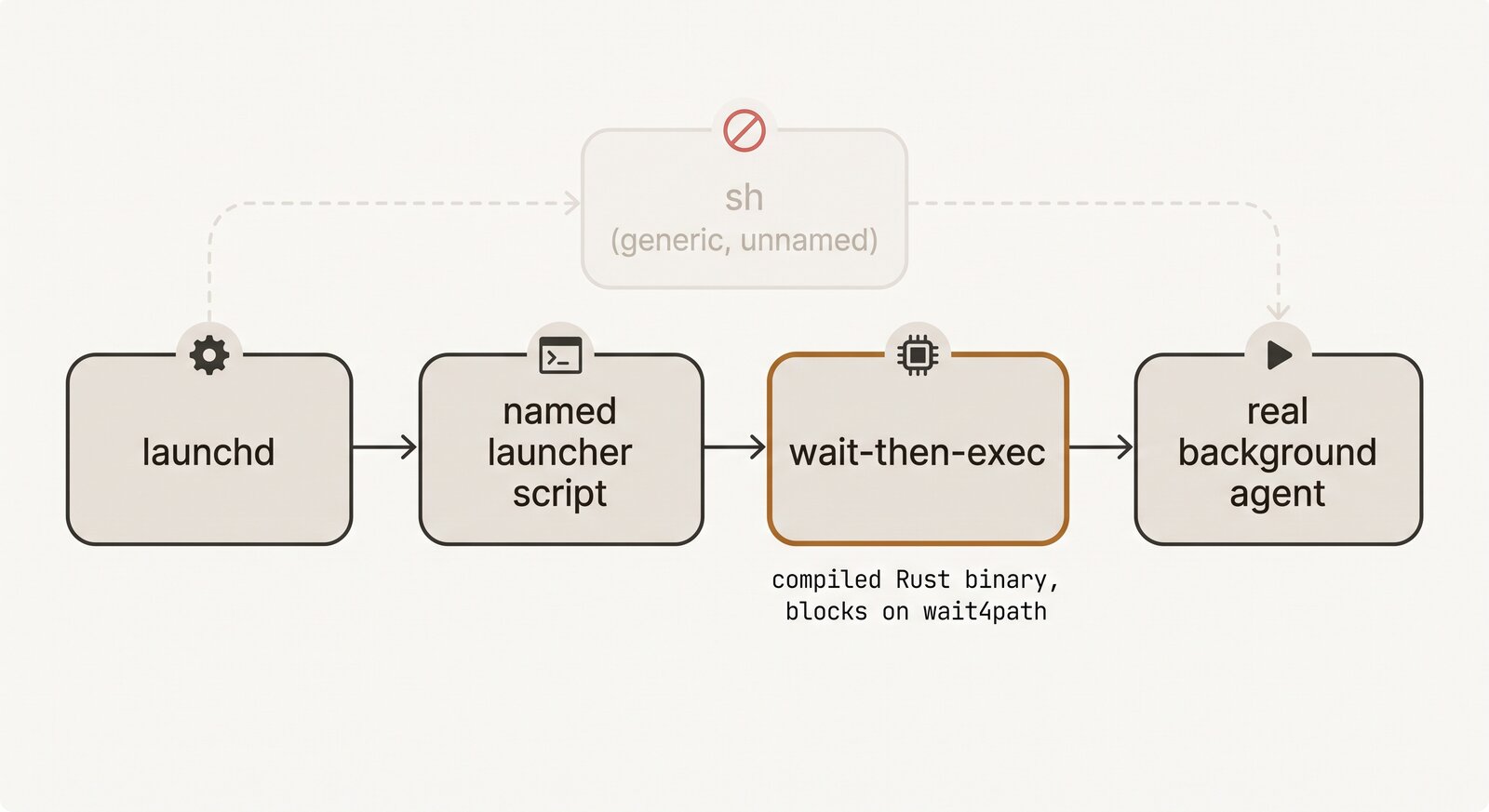
What launchctl print actually showed
The first diagnostic step was to print the launchd entry for one agent instead of guessing from the name in Activity Monitor:
$ launchctl print gui/501/com.usman.mlx-server
program = /bin/sh
arguments = {
  /bin/sh
  -c
  /bin/wait4path /nix/store && exec /nix/store/…-mlx-server/bin/mlx-server
}
program was /bin/sh. The real binary, mlx-server, sat inside a shell command string, where nothing that reads ProgramArguments[0] can see it. As far as launchd is concerned, sh is what it started, so macOS shows sh.
I checked whether I had written this wrapper and forgotten it. I had not. It is home-manager's default: every launchd.agents.<name> block it generates gets wrapped this way by default, controlled by an option called waitForNixStore (default true). The doc comment on that option explains the wrapper's job. /nix/store is a separate mount, and right after boot at login nothing guarantees it is mounted yet. wait4path is Apple's helper for this case: it blocks until a path exists, then proceeds. Without it, an agent that starts too early can fail because its binary is not there yet.
So the wrapper solves a real timing problem, and the price is the process name.
Two modes, and neither one is right
Reading modules/launchd/default.nix in home-manager's source (the module logic, not the docs) showed exactly two settings and nothing between them:
waitForNixStore = true(default):ProgramArguments = ["/bin/sh" "-c" "/bin/wait4path /nix/store && exec <cmd>"]. Waits correctly. Shows assh.waitForNixStore = false: home-manager writes a named launcher script andexecs straight into it. There is nowait4path, no shell wrapper, and the process name is correct. Nothing waits for the store to mount.
The home-manager docs say false risks the agent failing to start if launchd runs it before the store is mounted. That risk is real for anything with RunAtLoad = true, because that setting fires at exactly this moment.
My first pass, a day earlier, took the conservative route. I set waitForNixStore = false on the five agents that are safe by construction: mlx-server, git-sync-repos, odysseus-vm-autostart, opencode-agent-watcher, and vpn-keepalive. All five have RunAtLoad = false, so they start well after login and the store is already mounted. That left the agents with RunAtLoad = true on the sh wrapper, among them gpg-agent, bedrock-token, codeartifact-token, the SSM tunnel agents, docker-vm-autostart, headroom-proxy, and notif-poller. I could live with the wrong process name, but not with an agent that fails to start at login.
I then audited every remaining sh-wrapped agent. That made fifteen: thirteen I could fix, and two that I could not. org.nixos.aerospace comes from nix-darwin's own launchd module (launchd.user.agents, a different code path), which hardcodes the same sh -c "wait4path && exec" pattern with no toggle. I confirmed that in its source. org.nix-community.home.sops-nix does go through home-manager's mechanism, so the toggle exists, but overriding an external module's internal agent definition to inject a wrapper was not worth it for one process. Both stay wrapped, on purpose.
The thirteen were stuck between a correct name without the store wait and the store wait under the name sh.
Building the missing mode
Since home-manager offers two settings, I added a third outside its control. The requirement was to wait for /nix/store, then exec into the real command, with ProgramArguments[0] being something other than /bin/sh.
A shell script fails this requirement, because program would still read as the shell that interprets it. It had to be a compiled binary, so I wrote one in Rust and built it with pkgs.writers.writeRustBin. It compiles as part of the flake and needs no separate toolchain step:
fn main() {
    let args: Vec<String> = env::args().collect();
    if args.len() < 2 {
        eprintln!("usage: wait-then-exec <real-command> [args...]");
        std::process::exit(1);
    }

    // Block until /nix/store is mounted. This is the same helper
    // binary that home-manager's own wait4path wrapper calls.
    let _ = Command::new("/bin/wait4path").arg("/nix/store").status();

    // Replace our own process image with the real target.
    // On success this never returns.
    let err = Command::new(&args[1]).args(&args[2..]).exec();
    eprintln!("wait-then-exec: exec failed: {err}");
    std::process::exit(127);
}
The exec() call does the important work. std::os::unix::process::CommandExt::exec replaces the current process image instead of forking a child. No wrapper process lingers after the handoff, exactly as with the shell wrapper's exec, minus the shell.
To wire it in, I set waitForNixStore = false so home-manager stops inserting its wrapper, and prepended the binary to ProgramArguments. Here is gpg-agent, before and after:
# before
gpg-agent = {
  enable = true;
  waitForNixStore = true;
  config = {
    Label = "org.gnupg.gpg-agent";
    ProgramArguments = [
      "${pkgs.gnupg}/bin/gpg-agent"
      "--homedir" "${home}/.gnupg"
      "--use-standard-socket"
      "--daemon"
    ];
    RunAtLoad = true;
    # ...
  };
};

# after
gpg-agent = {
  enable = true;
  waitForNixStore = false;  # wait-then-exec handles the wait instead
  config = {
    Label = "org.gnupg.gpg-agent";
    ProgramArguments = [
      "${waitThenExec}/bin/wait-then-exec"
      "${pkgs.gnupg}/bin/gpg-agent"
      "--homedir" "${home}/.gnupg"
      "--use-standard-socket"
      "--daemon"
    ];
    RunAtLoad = true;
    # ...
  };
};
One line added to ProgramArguments, one boolean flipped. The resulting chain has three hops and none is sh: launchd starts the gpg-agent launcher that home-manager writes when waitForNixStore = false, the launcher execs wait-then-exec, and that execs the real gpg-agent. I applied the same change to the other twelve entries in that batch. They are the mkSsmAgent generator (which produces every SSM tunnel agent), gpg-key-import, code-artifact-token, portless-proxy, portless-aliases, codeartifact-token, bedrock-token, opencode-vm-autostart, headroom-proxy, notif-poller, meeting-notifier, and docker-vm-autostart in both the Lima and Colima variants. The generator counts once however many tunnels it produces, and docker-vm-autostart counts once for its two variants, which is how the total reaches thirteen. The five RunAtLoad = false agents from the first pass did not need the wrapper.
What it took
Two days went from root cause to shipped fix. Day one found the waitForNixStore option and did the five-agent split. Day two audited the remaining fifteen sh-wrapped units, set two aside as unfixable, and applied the wrapper to the other thirteen. "It builds" was not enough for verification. The full home-manager generation had to succeed for both darwinConfigurations, and I read the generated launcher scripts for bedrock-token and one SSM tunnel on disk to confirm each execs wait-then-exec before the real command.
The count: five fixed on day one, thirteen on day two, and two left alone on purpose. That is 20 agents in total, and only the two exceptions still show as sh.
The list has grown since. The agents added after this change include hister (a local browsing-history search server, RunAtLoad = true, so it goes through wait-then-exec), pr-review-check and agent-session-backup (both scheduled with RunAtLoad = false, so they use plain waitForNixStore = false). The rule I now follow for a new agent: if RunAtLoad is true, prepend wait-then-exec; otherwise set waitForNixStore = false and leave it. Part 16 covers pr-review-check.