One flake, two people: moving per-user config into one file each
How 17 commits of fork drift collapsed into one nix/personal file per person, and the audit process that keeps a shared nix-darwin flake shared.
This repo started as one person's dotfiles. Then a friend wanted the same declarative macOS setup on their own machine, forked the repo, and started editing. Names in this post are changed: I call them "the second user", and the fork's config file is friend-mac.nix here. Six weeks later the fork had 17 commits of drift: hardcoded usernames, hand-deleted secret keys, and a git.nix block that assumed everyone signs commits with my GPG key. Each upstream improvement I made had to be re-applied by hand to files the fork had already diverged from, and the divergence came from need, not choice.
The divergence-by-necessity problem
Carelessness did not cause this. The original files had no slot for "this value differs per person", so any difference had to go in as a direct edit. nix/home/git.nix hardcoded my name, email, and GPG signing fingerprint. The fork's dotfilesName did not match dotfiles-mac (the clone directory), so the gitdir:~/dotfiles/ conditional include never matched, and the second user deleted the whole signing block. nix/home/default.nix and nix/home/mac-default.nix had a hardcoded 10-key sops.secrets list, but the fork's encrypted secrets/opencode.yaml had only 3 of those keys. Activation failed until they hand-deleted deepseek_api_key and four MySQL keys from the module.
None of these were bugs in the usual sense. Each was a correct fix for one machine, applied in a file that both configs were supposed to share.
The fork audit that found this (docs/memory/2026-08-15-fork-audit-report.md) diffed the fork against the merge-base and sorted 16 touched files into four buckets: adopt as-is, parametrize, personal-only, or needs verification. The "parametrize" bucket mattered most. Every item in it was a real per-person difference that had been edited into a file that should have stayed byte-identical in both forks.
The fix: one file per person, nothing personal anywhere else
The rule that came out of this, in docs/FORK-SYNC.md:
Every time a file needs to differ between the two of us, the default instinct (hand-edit the file differently in each fork) creates permanent drift. Push every per-person difference into one file per person, keep every other
.nixfile byte-identical across both forks.
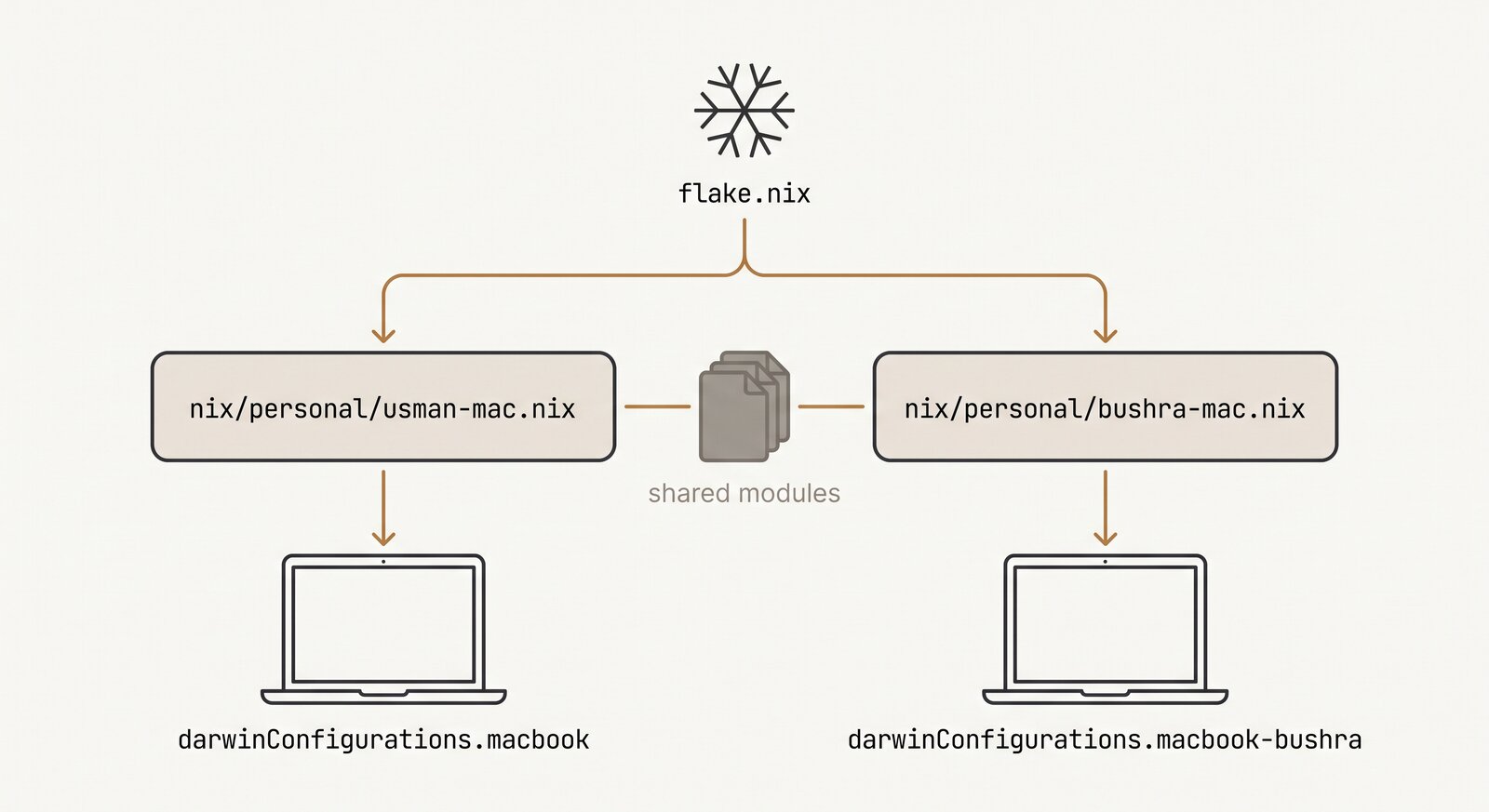
That gives nix/personal/usman-mac.nix and one file for the second user, called friend-mac.nix in this post. Each is a flat attrset with no logic and no conditionals. It covers identity, machine settings, git signing, and OpenCode model choices:
# nix/personal/usman-mac.nix
{
  username     = "usman";
  dotfilesName = "dotfiles";
  workName     = "acme";

  dockerRuntime  = "lima";          # "lima" | "colima" | "none"
  nextdnsProfile = "profile-a1b2c3";
  extraCasks     = [ "intellij-idea" ];

  gitUserName       = "wolfie";
  gitUserEmail      = "usman.akram@acme.example";
  gitSigningEnabled = true;
  gitSigningKey     = "REDACTED0000REDACTED0000REDACTED0000RED";

  sopsSecretNames = [
    "context7_api_key" "deepseek_api_key" "openrouter_api_key"
    "atlassian_mcp_token" "hf_token"
    "mysql_prod_user" "mysql_prod_password"
    "mysql_dev_user" "mysql_dev_password"
    "odysseus_admin_password"
  ];

  opencode.defaultModel = "amazon-bedrock/eu.anthropic.claude-sonnet-4-6";
  # ...
}
The second user's file has the same shape with different values. Where they have not supplied a real value yet, it holds an obvious placeholder instead of a wrong default:
# nix/personal/friend-mac.nix
{
  username     = "friend";
  dotfilesName = "dotfiles-mac";
  workName     = "beta";

  dockerRuntime = "colima";

  # TODO: replace with your real name/email.
  gitUserName       = "CHANGE_ME_friend";
  gitUserEmail      = "CHANGE_ME@example.com";
  gitSigningEnabled = false;
  gitSigningKey     = null;

  sopsSecretNames = [ "context7_api_key" "openrouter_api_key" "atlassian_mcp_token" ];
}
flake.nix imports both files once and spreads the whole attrset into every specialArgs and extraSpecialArgs block that needs it:
usmanMac   = import ./personal/usman-mac.nix;
friendMac  = import ./personal/friend-mac.nix;

darwinConfigurations.macbook = nix-darwin.lib.darwinSystem {
  specialArgs = { inherit inputs; } // usmanMac;
  modules = [ /* ... */
    { home-manager.extraSpecialArgs = { inherit inputs; } // usmanMac; }
  ];
};

darwinConfigurations.macbook-friend = nix-darwin.lib.darwinSystem {
  specialArgs = { inherit inputs; } // friendMac;
  modules = [ /* ... */
    { home-manager.extraSpecialArgs = { inherit inputs; } // friendMac; }
  ];
};
The spread matters more than it looks. Before it, flake.nix held five separate inline attrsets per person, one for each flake target (nixosConfigurations.default, two homeConfigurations, two darwinConfigurations), each with slightly different keys. Two commits replaced those five blocks with one-line spreads, and the second deleted 31 lines of inline attrsets in exchange for 5 lines of { inherit inputs; } // usmanMac. Adding a personal setting now touches one file, your own.
sopsSecretNames: the guard that makes a short list safe
The secrets list needed more than parametrizing, because the consuming modules had to change too. mac-default.nix used to declare a fixed 10-key sops.secrets block. sops-nix fails activation if a declared secret is missing from the decrypted file. That is why the second user had to hand-delete keys instead of listing fewer of them.
The fix uses sopsSecretNames as the source list, and every optional consumer checks that its secret exists before using it:
# nix/home/opencode-agents.nix
optionalSecretEnvVars = [
  { name = "deepseek_api_key";   envVar = "DEEPSEEK_API_KEY"; }
  # ...one entry per optional secret
];

# Only emit an `if` block for secrets this person declared.
# A missing secret is skipped instead of raising a nix eval error.
secretEnvFishLines = lib.concatMapStrings (s:
  lib.optionalString (config.sops.secrets ? ${s.name}) ''
    if test -f ${config.sops.secrets.${s.name}.path}
      set -gx ${s.envVar} (string trim < ${config.sops.secrets.${s.name}.path})
    end
  ''
) optionalSecretEnvVars;
A three-key list and a ten-key list both activate cleanly now. They differ only in which environment variables get set, and nobody edits the shared file.
The OpenCode config: from a static file to a generated one
~/.opencode/opencode.json used to be a checked-in JSON file. Model choices, provider credential structure, agent prompts, and MCP server definitions all lived in that one file, and both forks edited it directly. Every model change risked a merge conflict.
That file no longer exists as a static artifact. The shared parts (agent prompts, colors, permissions, provider skeletons, MCP structure) moved to nix/lib/opencode-template.nix. The per-person choices (defaultModel, which providers to include, agentModels, extra project references) live in each person's nix/personal/*.nix under an opencode key. nix/home/ai-tools/opencode.nix merges the two and writes ~/.opencode/opencode.json at darwin-rebuild switch time. Before deleting the static version, I compared the generated output with the old file using a Python deep diff. The values matched, and only the JSON key order differed.
The second user's opencode block picks different providers (github-copilot models only, no amazon-bedrock, deepseek, or mlx) without touching a shared line.
I did this in three passes: notice a hardcoded personal value, move it into nix/personal/*.nix, repeat until nothing personal is left inline. Designing the abstraction up front would have been faster, but the passes found every instance. Grepping for my username afterward turned up cases a design pass would have missed.
What stays deliberately unsynced
Not everything should be parametrized. docs/FORK-SYNC.md lists files that the sync tooling never touches:
.sops.yamlandsecrets/*.yaml. Each machine has its own age key, and sharing these would mean sharing the private key.- Each person's own
nix/personal/<name>-mac.nix. Upstream keeps improving the other person's file and the shared consumers, and your own file is yours. - AeroSpace workspace assignments and sketchybar icons. These are personal preference, not config bugs.
- One-off opt-ins such as the .NET SDK, a
dabfish function, andollama. Only one of us uses them, so they stay out of shared files instead of sitting behind a flag nobody else needs.
A setting is parametrized when both people need their own version of it, like git identity, the secrets list, or the docker runtime. A setting is personal-only when one person needs it at all. Forcing a personal-only setting into a shared file behind a flag only adds complexity for the other person.
scripts/sync-fork.sh and the audit direction that caught things
Pulling upstream changes into a fork is the easy direction. scripts/sync-fork.sh fetches, diffs from the merge-base (raw branch tips are mostly noise on a long-lived fork), and runs a scoped git checkout upstream/master -- <file> for everything not on a hardcoded PROTECTED list:
PROTECTED=(
  ".sops.yaml"
  "secrets/opencode.yaml" "secrets/keys.yaml" "secrets/hermes.yaml"
  "nix/personal/${PERSONAL_FILE}"
  "scripts/sync-fork.sh"   # never self-overwrite mid-run
)
The harder direction, pulling the fork's changes into upstream, is the one that surfaced the drift, because it is an audit and not a merge. I have no push access to the fork. I run gh repo clone, diff against the merge-base, and sort every touched file into adopt, parametrize, personal-only, or needs-verification.
That process found three things. The tealdeer cache path on macOS is ~/Library/Caches/tealdeer, not ~/.cache/tealdeer. The fork's fix was right, and my activation step from Part 9 re-ran tldr --update on every activation. The fork's extraBrews also included the lima Homebrew formula, which mine lacked. Finally, a nvim-jdtls to jdtls nixvim rename tracked a real upstream change, not a personal preference. A blind three-way merge would have accepted or rejected that rename without asking why the option name changed. The sorting step forces the question.
The lesson
A shared config file with no per-person slot does not stay shared. The first time someone hits a value that does not apply to them, they edit it, and the file splits into two copies. Give every per-person value one legitimate home before anyone needs to make that first edit. The same one-home rule shaped how I later moved agent skills into the flake in Part 13.